


Physocarpus
Discover Physocarpus from Proven Winners®! These plants have beautifully cut leaves with striking colours. A robust shrub that flowers abundantly in late spring with white-pink flowers and requires hardly any maintenance.
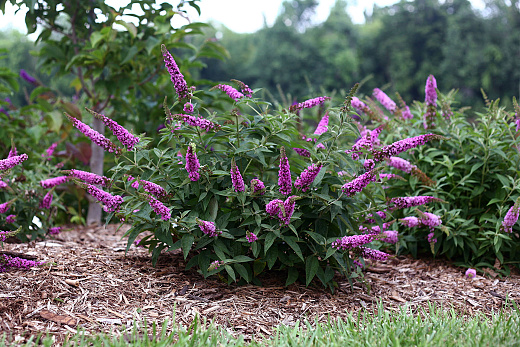

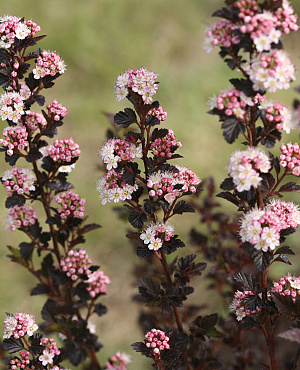

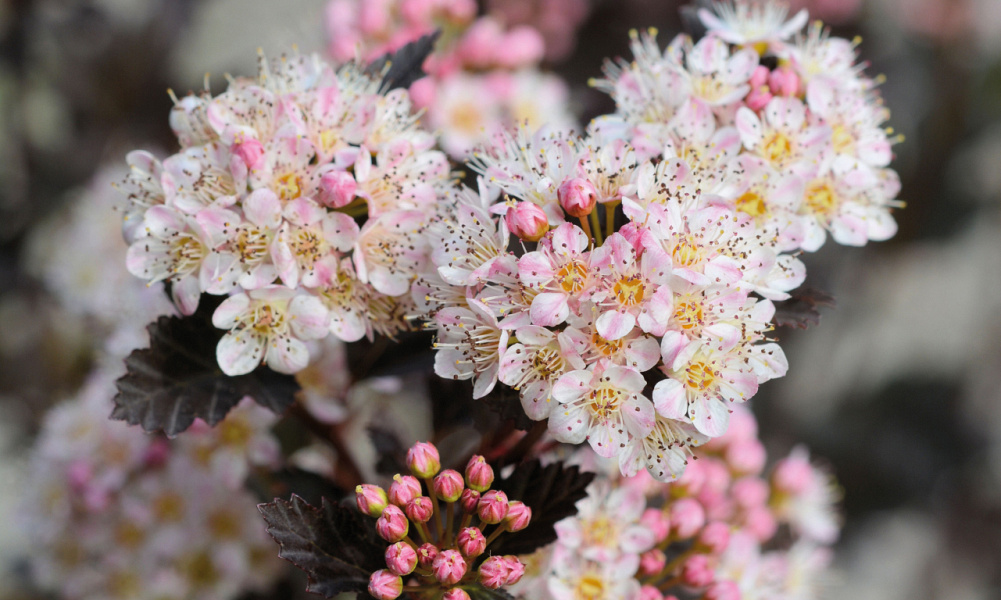
Physocarpus (Ninebark): decorative foliage and rich flowering in one shrub
Physocarpus, better known as Ninebark, is a deciduous shrub that has ornamental value throughout the season. In May, it blooms with white to light pink clusters of flowers, and in summer and autumn it stands out for its beautiful coloured leaves. It is a robust shrub that requires little care and is very hardy.
The Proven Winners® range includes selections such as Tiny Wine®, Tiny Wine® Gold and Summer Wine® Black. These varieties are more compact, with refined leaves and richer colours, making them suitable for both small city gardens and larger borders.
Location and growth
The shrub grows best in the sun. The sunnier the spot, the more intense the leaf colour. Physocarpus has few soil requirements and grows in all soil types. When planting, it is wise to mix compost into the soil and leave room for natural growth.
Care and pruning
Physocarpus requires little maintenance. Pruning after flowering keeps the shrub compact and stimulates new shoots. Periodically removing old branches keeps the plant young and flowering profusely.
Use in the garden
Thanks to its colour and structure, Physocarpus is very versatile. It can be planted alone as an eye-catcher, but also works well in groups in a border or as a loose hedge. Dark varieties such as Summer Wine® Black and Tiny Wine® add depth and contrast, while Tiny Wine® Gold adds a fresh, light colour. Due to their compact growth habit, these varieties are also suitable for small gardens or front gardens where space is limited.
Physocarpus in your garden!
Physocarpus is a strong, versatile shrub that remains attractive in every season. With the Tiny Wine®, Tiny Wine® Gold and Summer Wine® Black selections from Proven Winners®, you are choosing compact growth, refined leaves, striking leaf colours and reliable hardiness.
FAQ
When does Physocarpus flower?
Physocarpus usually flowers in May. During this period, dense clusters of small flowers in shades of white to light pink appear. The flowers provide an elegant contrast to the often dark-coloured foliage and also attract bees and other pollinators.
How big does Physocarpus grow?
Classic varieties often reach 1.5–2.5 m. Compact Proven Winners® selections such as Tiny Wine® remain around 1.5–1.8 m and are therefore also suitable for smaller gardens.
How and when should I prune Physocarpus?
For topiary pruning: immediately after flowering (in summer), so that you do not cut away the flower buds for the following year. Regular pruning is not necessary. For rejuvenation, you can remove some of the oldest, thickest branches down to the base every 3–5 years; this is best done in late winter before sprouting.
Can Physocarpus be planted in (partial) shade?
Yes, partial shade is fine. But for the most flowers and the best colour, plant the plants in full sun.
What Proven Winners® varieties are available?
These include Tiny Wine®, Tiny Wine® Gold and Summer Wine® Black – compact, richly flowering and with strong leaf colours; moreover, they are low maintenance.