


Chaenomeles
Discover the thornless Chaenomeles collection from Proven Winners®! This spring bloomer will give your garden an explosion of colour with flowers that appear early in the spring. Strong, richly flowering and ideal as a hedge or eye-catcher in a border. The branches also look beautiful in a vase!
.JPG?1752236528)
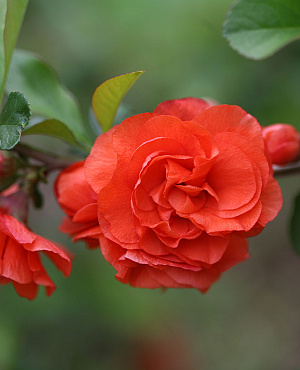

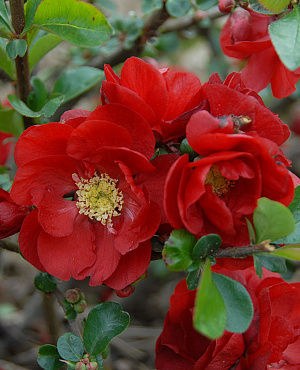
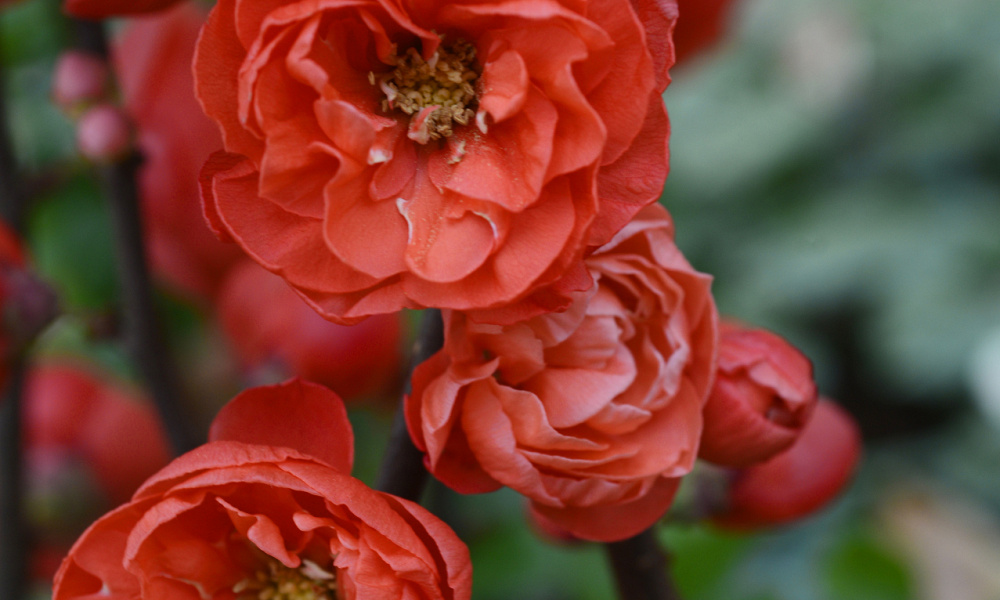
Chaenomeles (Japanese quince) – early spring bloomer with very rich flowering
Chaenomeles, or Japanese quince, is one of those shrubs that brings the garden to life early in spring. Often as early as March, when most plants are still dormant, it bursts into bloom with its rose-shaped flowers in red, pink, orange or yellow. Your garden will be filled with colour in no time!
Oriental roots, modern eye-catcher
This shrub originates from East Asia and grows compactly, usually reaching a height of around 1 to 1.5 metres. In summer, it has fresh green leaves and in autumn it can produce small fruits, also known as quinces. These are edible after preparation, but above all they add extra decorative value.
Why you want Chaenomeles
The special thing about Chaenomeles is its timing: it is an early spring bloomer and flowers like almost nothing else. This makes it a real mood creator in a border, as a low hedge or even in a pot on the terrace.
The Storm® series from Proven Winners® takes it a step further: these varieties have no thorns. This not only makes them safer and easier to maintain, but also ideal for areas where children or pets play.
Where does it feel at home?
Place Chaenomeles in full sun for the richest flowering. Light partial shade is also possible, although it will flower less profusely there. The soil? As long as it is well-drained, you're good to go – from sandy soil to clay. For a hedge or group, keep about 80 cm between plants, as they can grow to about 120 cm wide. Thanks to their compact growth, the Storm® varieties are also ideal for smaller gardens or front gardens.
Easy to enjoy, year after year
Chaenomeles is a shrub that requires little attention. Prune immediately after flowering to keep it compact and young, give young plants some extra water during dry periods and sprinkle a little compost or manure in the spring. That's all it needs to produce plenty of flowers every year.
How to use Chaenomeles in the garden
With its early flowering, Chaenomeles really sets the mood. Plant several along a path or use it as a low hedge. And because the Storm® series has no thorns, you can plant it close to your patio or seating area without any worries. It also makes a fantastic start to the season in a large pot. You can also cut the flowers to put in a vase!
Four colours, four times spring
With the Storm® series, you can choose from four colours, each with its own vibe. All are double-flowered and thornless.
• Mango Storm® – soft orange (red), sunny and fresh.
• Orange Storm® – bright orange, a real eye-catcher.
• Pink Storm® – cheerful pink, perfect for a fresh touch.
• Scarlet Storm® – deep red, stylish and powerful.
Whether you go for one powerful colour or a colourful mix, there is always a Storm® to suit your garden.
FAQ
Is Chaenomeles hardy?
Yes, the Storm® varieties are reliably hardy down to -25 degrees!
When does Chaenomeles flower?
Usually from March onwards, often for weeks – depending on the weather. The Proven Winners® varieties often continue to produce flowers throughout the summer (but less profusely than during the spring flowering).
How do you prune Chaenomeles?
Prune immediately after flowering to keep it compact and occasionally remove an older branch for rejuvenation.
Are the fruits edible?
Yes, the quinces are edible when properly prepared. Eating them raw is not recommended.
Can Chaenomeles be grown in a pot?
Yes, especially the compact Storm® varieties do well in a spacious pot or container.